Moving the goal line?

Photo by Pixabay on Pexels.com

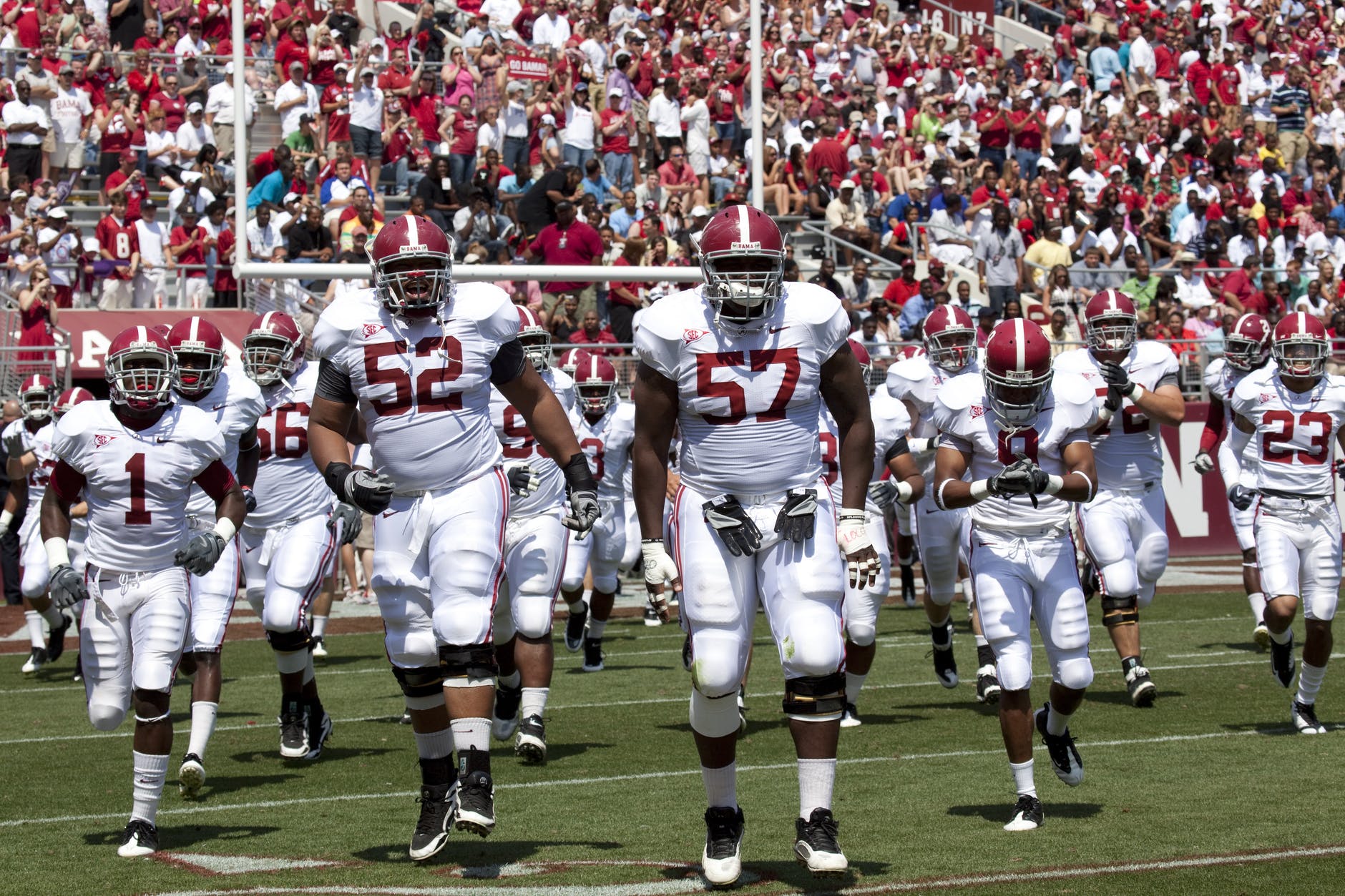
For months Alabama football fans have been expecting an announcement about whether the Crimson Tide football team would be storming out on the gridiron in 2020. Because of the logistics of running a football program it was thought that a decision would be made by mid-July. It was estimated that it would take at least six weeks of preparation before the first game was played.

As the toll from the Coronavirus epidemic increased, many people were hoping that the season would be postponed for a year. Fans had mixed emotions according to Al.com‘s Michael Casagrande. He wrote about John Wills who was not planning on going to games after his wife had been hospitalized for two weeks after coaching Million Dollar Band Crimsonettes at a twirling competition in Ohio.

It was not until the end of July that there was a hint about any plans for the University of Alabama‘s football team. On July 29th an article by Cecil Hurt in the Tuscaloosa News reported on an email that had been sent by the University’s Director of Athletics Greg Byrne. Although the actual schedule had not been finalized, he informed season ticket holders and members of Tide Pride about the possibility of a “modified seating model.” He said that “those affected will have the option to elect a complete or partial refund of Tide Pride contributions and ticket purchases.”

The University of Texas Athletic Director Chris Del Conte recently told Longhorn fans that its stadium capacity would be at 50%. Similar plans were being made at the University of Houston. The University of Michigan anticipates having reduced crowds in the stadium. Ohio State‘s Athletic Director Gene Smith, as far back as in May, said that the Buckeyes might be playing before a stadium that was only about 30% full. At one time schools on the West Coast were actually contemplating canceling their seasons.

According to NCCA-FB‘s Dennis Dodd, the NCAA 2020 college football season was hanging in the balance due to uncertainties about the NCAA’s minimum testing requirements. Dodd wrote:

“Where is the panic button?” asked Dr. Michael Saag, an infectious disease expert at the UAB School of Medicine. “Where is the number of positive tests that makes the administration say, ‘OK we’ve got to cancel this week’s game?'”

There was an article in the Washington Post “On a call with SEC leaders, worried players pushed back: ‘It’s not good enough.'” by Robert Klemko and Emily Giambalvo. They reported on the concerns of players about reopening “a multibillion dollar industry afloat amid the novel coronavirus pandemic.” They quoted an unidentified SEC spokesman who said, “We’re going to have cases on every single team in the SEC. That’s a given. And we can’t prevent it.”

Al.com‘s Joseph Goodman addressed the complexities of playing football in the Southeastern Conference during a pandemic:

SEC presidents voted to scrap non-conference games on Thursday, but add two to everyone’s league slates. It feels a lot like a Hail Mary amid a hail storm. Pushing the season back three weeks to buy time is a great plan, and I’m hopeful that the number of coronavirus cases in the South will drop to acceptable levels by then. It’s not time to relax, though.

We know what happens when people let their guards down too early with the coronavirus.

You want preseason stats? Alabama reported 1,923 new coronavirus cases on Thursday morning, and there were 1,598 hospitalized people in the state due to COVID-19-related health problems. We’re under a state-wide mask order until Aug.31. Football can wait.

These altered league schedules we’re seeing around the country are nothing to celebrate. They’re necessary cash bailouts because college football pays the bills and keeps the lights on for non-revenue sports. If universities weren’t desperate for television money from ESPN and CBS, then league presidents would not be voting to play games.

They’re going to try and have college football, but the stadiums will be mostly empty. We’re hoping for football, but it’s still going to require a commitment from the public to follow rules. Tailgating? Nah. Not this year.

Grim statistics were recently reported in Al.com‘s Ramsey Archibald‘s article “Coronavirus deaths already well past average annual flu deaths in Alabama.” He said that it “has now been clear for some time – COVID-19 is not ‘just a bad flu.’ Alabama hasn’t suffered more than 1,268 flu deaths in any of the last 20 years – a number the coronavirus has already topped.” Archibald said that epidemiologists were concerned, that when the flu season begins, the two viruses could “potentially overlap in busy hospitals.”

In addition to the over thirty thousand University of Alabama students that are expected to return to the Capstone, having upwards of fifty thousand football fans enter the mix in T-Town is entering uncharted territory. There is already a great amount of uncertainty involved in reopening the campus.

Will Tuscaloosa become a giant petri dish for the Coronavirus in the Fall or will everything go as planned? Will students and fans act responsibly by social distancing and wearing masks, before and after the games? Will football players remain healthy? It can fairly be said that there has seldom been a football season in T-Town that is as much on the minds of its residents as this one has been.

Standard

To Mask Or Not To Mask?

Photo by Startup Stock Photos on Pexels.com

There hasn’t been much mention of COVID parties lately on Facebook group pages. Before the Fourth of July there had been a spate of articles about alleged parties that had taken place in T-Town, the purpose of which had been said was for party goers to compete in becoming infected by the Coronavirus. None of the culprits, who were said to have been involved in them by a local doctor, have ever been found.

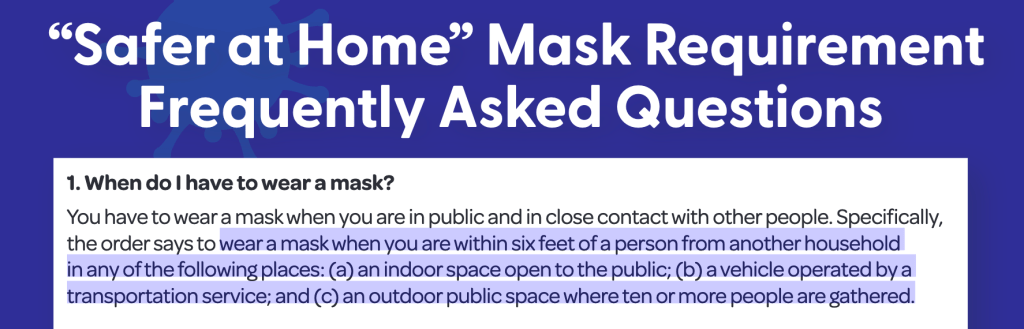
A statewide mask order that was issued by Governor Ivy went into effect on July 16th. It will be in effect at least until July 31st. The order was issued after a significant statewide uptick in COVID related hospitalizations. A city mask ordinance in Tuscaloosa had already been in effect since July 6th which would have applied until August 5th. The state order superseded any local regulations. There has been a mixed response to the mask order.

There had been the ongoing debate between mask skeptics and those who believe in masks, Caitlan McCabe’s article in the Wall Street Journal “Face Masks Really Do Matter. The Scientific Evidence Is Growing” supported the use of masks. She discussed among other things that “research suggests that face coverings help reduce the transmission of droplets.”

One major concern that has increasingly been discussed on Facebook has been the return of nearly 30,000 university students to T-Town. Many permanent residents looked at the inevitable reopening of the University of Alabama with trepidation. There was also concern expressed by Safe Return UA, a staff, faculty and student-led campaign. Safe Return UA called for “universal COVID-19 testing, adequate family and medical leave, employment protections and public accountability for the upcoming academic year at the University of Alabama.”

Al.com‘s Dennis Pillion reported on the plans to test every college student in the state. He quoted the University of Alabama Birmingham‘s Dr. Michael Saag as having said that “every student is going to be asked to wear a mask, as well as all the staff and the faculty on the campus to try to mitigate the spread while they’re there. My hope is that if everyone’s wearing a mask when they’re out and about, when they’re inside enclosed spaces.”

According to Pillion, Sang explained that the testing will involve samples from multiple students — five to 10 at a time, depending on the circumstances — which will be combined. If the pooled sample tests negative, all the students in the pool are negative. If the pooled sample tests positive, the lab can then test the individual samples to find which students in the pool are positive.

“‘The thing that will throw us off is if the prevalence in the community of students is over 4%,” Sang said. “We don’t anticipate that based on preliminary data that we have so far, but it’s very fluid, and we’ll have to see what we get.”

The University of Alabama‘s Return Plan leaves many questions to be answered.

In terms of the plan’s safety practices there seems to be a good deal of reliance on voluntary cooperation. “Individuals who fail to complete these measures will be asked to repeat the training. Continued non-compliance will result in further review through the Office of Student Conduct or Human Resources and could result in dismissal. We will continue with messaging on the importance of and requirement to wear face coverings and other PPE. In keeping with Crimson Tide tradition, we are confident the University community will join together to help each other.”

Should the state or city mask orders expire there would be no obligation for students to wear masks in public in off-campus areas.

“Face coverings are required in all UA facilities, with limited exceptions. A face covering is not required in your own room or suite in University housing. However, it will be required in common areas, like residence hall lobbies. We also strongly encourage you to use a face covering in all public settings.

“Face coverings are required inside all University-owned buildings, and outside during on-campus gatherings and in other on-campus settings where social distancing is difficult to maintain.”

“Along with your personal room and suite in University housing, you do not have to wear a face covering in enclosed offices, enclosed study spaces, your vehicles, outdoors where distancing is met and when doing certain physical activities such as working out at specified University Recreation facilities. Although not required in these instances, use of a face covering in all settings is strongly encouraged.”

In order to keep the “campus community as safe as possible during the school year,” some students are being moved from residence halls to the off-campus Loft apartments.

“We apologize for any inconvenience, but we expect the new facilities to be comparable or an enhanced option to students’ previous assignment, including a private bathroom for each resident, and a washer/dryer in each apartment. Every effort was made to assign students with roommates in their roommate group, possibly along with one additional student. Students still live under the HRC housing contract, which will last only for the academic year, although students will have the option to remain through July 2021, at no additional cost. Students will pay a reduced rate, and utilities will be included.

“Crimson Ride will also provide transportation between campus and the Lofts. We understand this is unexpected news, and we regret that it may add to what has without doubt been an uncertain few months. The University does not make the change lightly, but only because of its obligation to be proactive in planning for capacity issues while following the guidelines outlined in the University’s Plan for a Return to Full Operations and keeping the campus community as safe as possible during the school year. Students who instead prefer to make their own off-campus arrangements may cancel their housing contract if they prefer.”

The usually crowded and hectic Sorority Rush will initially conducted online. “Most sorority recruitment rounds, which begin Saturday, Aug. 8, will be held virtually, with potential new members interacting with current sorority members via Zoom.”

In terms of campus gatherings and Greek activities “personal responsibility” for safe behavior is called for.

“Social events and group experiences will be planned to preserve the experience, consistent with health and safety requirements. Details will be released for each event. Students should take personal responsibility to protect themselves and others from infection.

“Student groups, including Greek organizations, are strongly encouraged to move events outside and use online meeting platforms when possible. Student groups must abide by all stated occupancy limitations when hosting events or gatherings indoors.”

How off-campus activity will be regulated, if at all, is uncertain although on-campus activities have restrictions.

“UA, in compliance with the UA System Health and Safety Plan, has implemented additional restrictions on certain events in an effort to further mitigate the spread of COVID-19. Event attendees should enter a facility or event only after having completed the Healthcheck assessment tool.”

Recently, even after the statewide mask order, young people who were not wearing masks and were standing shoulder to shoulder have been observed outside of bars that traditionally serve students. The order stipulates that masks should be worn by people who are within 6 feet of a person from another household. In order to eat or drink masks would need to be removed of course.

The Tuscaloosa Rotary Club had a “socially distanced” meeting with University of Alabama President Andrew Bell as its guest speaker. Apparently pictures on Instagram showed that a distance of six feet between Rotarians was maintained. It took a fairly large ballroom to maintain such distancing for fewer than forty people. There are few comparable spaces available in campus bars.

There have been problems with fire code violations at venues that University students have frequented. No details were provided by Tuscaloosa’s Fire Chief Randy Smith about the 22 businesses in May that were in violation of the Alabama Department of Public Health’s reopening guidelines according to an ABC 33/40 story.

Alison Snyder in Axios reported, “More young people are being infected with the coronavirus, and even though they’re less likely to die from it, experts warn the virus’ spread among young adults may further fuel outbreaks across the United States.”

A fear of having student “super spreaders” of Coronavirus in the community exists for many permanent residents. They are not reassured by the University of Alabama‘s plans for reopening. Many of them have had previous experiences with students that caused them concern. A survey in 2012 by Tuscaloosa Neighbors Together reflected a general antipathy towards student housing.

The pandemic will perhaps provide an opportunity for the University of Alabama and its students to regain the trust of the permanent residents of T-Town.

Standard

Covid Parties in T-Town?

Photo by Emre Kuzu on Pexels.com

T-Town has been in the national news lately because of stories about COVID-19 parties. Bruce Y Lee wrote an article “Are Covid-19 Coronavirus Parties Really A Thing In Alabama?” in Forbes magazine that said:

A recent example is from Tuscaloosa, Alabama. Allegedly, college students there have been holding such Covid-19 parties in which attendees pay an entry fee, someone brings the SARS-CoV2 with him or her to the party, and the first person who ends up gets infected at the party then wins the collective pot of entry fees.

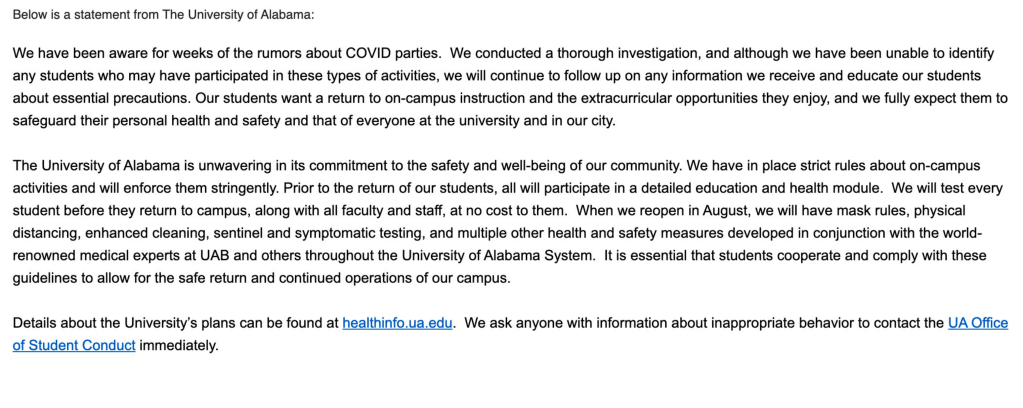
Lee posted the University of Alabama‘s disclaimer. You shouldn’t expect a mea culpa from the school unless iron-clad evidence is available of course.

One thing that is certain. Any nationwide publicity about COVID-19 parties in Tuscaloosa was the last thing that the University of Alabama wanted just before re-enrollment began. 

The difficulty in identifying any student who may have been involved shouldn’t be too surprising. In the case of a Rockland County suburb nine guests at a posh party tested positive. Subpoenas were necessary for the local authorities to get the names of any of the infected guests.

Stories had been circulating in T-Town about the COVID parties for weeks. A Tuscaloosa Council woman Cynthia McKinstry had even mentioned them in a committee meeting.

Then Tuscaloosa Fire Chief Randy Smith, at a Pre-Council meeting on June 30th, stated that “The one thing that we have seen over the past few weeks were parties going on in the city, county and several locations where students or kids would come in with known positives. We thought that was a rumor at first. We did some additional research, not only at the doctor’s office but at the state and they had the same information.”

He also said that some of the people who were tested used out-of-state IDs. That would indicate that some of the people involved were students whose permanent residence was not in Tuscaloosa.

Mark Hughes Cobb reported in the Tuscaloosa News what a local doctor had said:

Dr. Ramesh Peramsetty, a local physician who has been actively posting on West Alabama social media groups regarding pandemic testing and screening, from the perspective of his First Care and Crimson Care clinics, said COVID party stories have been going around for weeks. He posted what he’d heard about them as far back as June 8.

“While my nursing staff was triaging patients for COVID-19 swabbing, they were told about the COVID-19 house parties and were even shown videos of the parties by college students,” Peramsetty said.

“When students are called for results, we noticed that some were very excited and happy that they were positive, while others were very upset that they were negative.”

Although Dr. Peramsetty may not have viewed the videos, he felt confident enough in what his staff had told him to mention them.

However, if any of the videos had ever been posted on social media sites they seem to have been scrubbed. Conceivably the subjects in the alleged COVID party videos may have decided that perhaps they shouldn’t be feeling all that proud about them. If University of Alabama students had been in the videos, then the University’s “thorough investigation” was certainly impeded.

In the University of Alabama‘s student newspaper The Crimson White featured Grace Schepis’s article “Local doctor: University left key clinic out of ‘corona parties’ investigation”

Schepis wrote, “While these rumors may have raised eyebrows, they’ve also raised concerns about the University’s preparedness for the fall.”

She quoted the University’s President Stuart Bell as having said, “I think everyone needs to take this virus seriously. And I think [people] are making rumors of almost anything you could imagine someone would say. We look, certainly within our leadership, among our SGA, among our Greeks, and are communicating to them the importance of making sure that you make good decisions and smart decisions, and we will continue to do that as a University.”

Schepis continued, “The University did not provide a specific description of its investigation, but The Crimson White is actively seeking that information. Despite Crimson Care’s close proximity to campus, Peramsetty said he was never contacted by the University throughout its investigation about possible instances of these parties or any related cases. Peramsetty said his staff have informed the City of Tuscaloosa, but not the University directly.”

She further reported:

Garrett Bridger Gilmore, an English instructor and organizer for Safe Return UA, thinks that there is a bigger lesson to learn from this incident. 

“Whether COVID parties really happened or not, this is an important lesson that we cannot only rely on individual choices to keep us safe when students return to campus,” Gilmore said. “Many of UA’s proposed policies rely on students who test positive to quarantine themselves, but they haven’t released details on who will be responsible for enforcing quarantining or how they will do it.”

On June 15, the University released a rudimentary plan for students to return to campus in the fall. The plan included quarantine measures for those who test positive while on campus and an optional contact tracking system for students, but even new additions to the plan have yet to provide details on enforcement.

“Without a public plan that accounts for how UA will implement universal testing and for what measures will be taken to ensure that students who are infected don’t carry on their lives like everything is normal, it’s hard for many university employees to believe that UA is taking COVID-19 as seriously as they say they are,” Gilmore said.

One thing is clear. In T-Town many people who were apprehensive about the reopening of the University of Alabama were hardly reassured about the COVID party stories.

Although younger people are certainly contracting the Coronavirus, older people are more likely to be at higher risk of serious illness.

Many residents were already aware of the non-stop partying that had been going on by University students who’d never left town after the school ended its face to face instruction in March. They also knew that some students had returned to the neighborhoods that are adjacent to the university. There had been newspaper accounts of campus bars where social distancing regulations had been violated. Some of these bars had been forced to close because their staff had been infected with the Coronavirus. In effect what had been going on in certain bars had been a form of COVID-19 parties–without the actual intention of the participants being infected.

Should any of the COVID-19 party goers have been University of Alabama students, for the University to announce that the students who were involved would not be allowed to re-enroll would greatly reassure T-Town residents. Contact tracing of all potentially infected persons is also needed. As it stands now, without any determination of who the people were who participated in the parties, there is no reason to think that they are not remaining in town and still not engaging in reckless behavior.

Standard