If it looks like a duck…

sugar-cookie-clipart-black-and-white-recipes-clipart-black-and-white


The code of ordinances for Tuscaloosa, Alabama §3-23(c) stipulates that:

Any person seeking a restaurant liquor license shall submit with its application the plans of its restaurant which shall include the following:

(1) The kitchen shall have a food preparation area and storage equipment necessary to prepare the items listed on the menu.

(2) The number of persons that may be served at one sitting must be listed and there should be space in said area for at least 15 square feet per person.

(3) A proposed menu shall be submitted. The following items will not be considered a meal if they are the only ones served by the establishment seeking a restaurant liquor license: Oysters, shrimp, crab claws, chips, pickles, meats and eggs, peanuts, pretzels, popcorn, sandwiches or any other food that the revenue officer considers not to fall within the definition of a meal as set out in Code of Ala. 1975, § 28-3-1(23).

Jason Morton reported in the Tuscaloosa News:

Tuscaloosa city officials unanimously approved a series of legal definitions that will formally define restaurants, bars and businesses that fluctuate between both.

The definitions also place restrictions on certain uses, such as bars or taverns, event spaces (such as banquet halls) and live entertainment venues.

Another part of the discussion is the addition of buffers around Queen City Avenue and the city’s historic districts to prevent night-oriented businesses from disturbing those who live in these areas.

These buffers have drawn strong opinions from those who stand to be affected.

Developer Phillip Weaver, who has renovated and upgraded a number of downtown structures, was not present for Tuesday’s vote, but this summer he questioned how far the city was willing to go to limit the use of certain buildings.

Weaver now owns the former AlaGasCo building located less than a block from Queen City Avenue on University Boulevard, which could stand to be affected by the new buffer rules.

He has said there was no plan to put a bar or business that stayed open until the early morning hours in there, but he may want a restaurant that converts to a bar and offers live music at about 10 p.m.

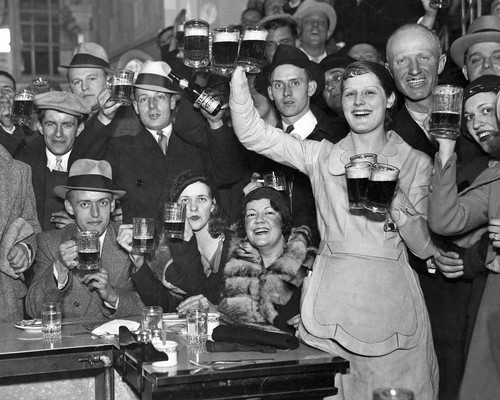
It might seem obvious to many people that any establishment that derives most of its revenue from alcohol sales should be considered to be a bar. A bar could also serve food if it so desires.

It would appear to some observers that some of the owners of businesses that serve alcohol want their establishments to be classified as restaurants in order to allow patrons to enter the premises who are too young to be served alcohol.

Would it be unreasonable to require that a restaurant be defined in terms of its being able to earn most of its revenue from food sales?

Maybe the “Duck Test” should be applied to establishments that sell booze?

If it looks like a duck, swims like a duck, and quacks like a duck, then it probably is a duck.”

Standard

Higher education & binge drinking

Young-man-drinking-and-driving-321639


Binge drinking has gone down for adolescents in the United States, which may be a consequence of successful national and state-level policies and programs on under-aged drinking. But in the alcohol drenched atmosphere of college life, binge drinking has sometimes become an even greater problem.

Jean Twenge, professor of psychology at San Diego State University, wrote:

But what about when they go to college and suddenly enter an environment where sex and alcohol are rampant? For example, although fewer 18-year-olds now binge-drink, 21- to 22-year-olds still binge-drink at roughly the same rate as they have since the 1980s. One study found that teens who rapidly increased their binge-drinking were more at risk of alcohol dependence.

The National Institute on Alcohol Abuse and Alcoholism‘s College Drinking Fact Sheet states:

Drinking at college has become a ritual that students often see as an integral part of their higher education experience. Many students come to college with established drinking habits, and the college environment can exacerbate the problem. According to a national survey, almost 60 percent of college students ages 18–22 drank alcohol in the past month, and almost 2 out of 3 of them engaged in binge drinking during that same timeframe.


About 1,825 college students between the ages of 18 and 24 die from alcohol-related unintentional injuries, including motor-vehicle crashes.  About 696,000 students between the ages of 18 and 24 are assaulted by another student who has been drinking. About 97,000 students between the ages of 18 and 24 report experiencing alcohol-related sexual assault or date rape.

About 20 percent of college students meet the criteria for an AUD. [Alcohol Use Discorder]. These include suicide attempts, health problems, injuries, unsafe sex, and driving under the influence of alcohol, as well as vandalism, property damage, and involvement with the police.


The City of Tuscaloosa, where the University of Alabama is located, may be just waiting for a lawsuit to happen because of its failure to enforce its own codes on under-aged drinking.

According to Alabama State Code Title 28 : 

It shall be unlawful: (a) For any person to sell, furnish, give to or purchase for any minor, alcoholic beverages; or to attempt to sell, furnish, give to or purchase for any minor, any alcoholic beverages.

Tuscaloosa’s City Code (Sec. 3-42. -Certain licensees not to admit under-aged persons) clearly states:

It shall be unlawful for a lounge liquor licensee, or manager, or other person in charge of the licensed establishment either directly, or by its servant, agent or employee, to admit or allow any person to be in, on, or upon said licensed premises in violation of any state law regulating the age of persons allowed on such premises.  

Could it be that the City of Tuscaloosa is taking the route of the Pinto auto-makers who knew that they were selling a defective product?  A simplified version would be that the automakers weighed the relative costs of litigation and correcting automobile design errors and decided that potential law suits were worth the risk.

Popular Mechanics’ “The Top Automotive Engineering Failures: The Ford Pinto Fuel Tanks” described industry thinking in this way:

Ford did a cost-benefit analysis. To fix the problems would cost an additional $11 per vehicle, and Ford weighed that $11 against the projected injury claims for severe burns, repair-costs claim rate and mortality. The total would have been approximately $113 million (including the engineering, the production delays and the parts for tens of thousands of cars), but damage payouts would cost only about $49 million, according to Ford’s math. So the fix was nixed, and the Pinto went into production in September 1970.

Or, the City of Tuscaloosa might find itself on the horns of a dilemma. There is a loophole in the law that allows most University students ( who are minors ) to be allowed into bars. Tuscaloosa’s downtown area has thriving businesses that serve alcohol and students feel as if they should be part of Tuscaloosa’s entertainment scene. It is impractical to expect the alcohol vendors to enforce liquor laws.

Alcohol Policy MD has described the problem in this way:

In many states throughout the country, minors – those under the legal drinking age of 21 – are permitted in bars unaccompanied by an adult. State and local regulations vary widely in the extent to which they permit minors to enter on-sale retail alcohol outlets

One thing is clear: allowing minors into drinking establishments such as bars and nightclubs is, in the words of one enforcement official, “a regulator’s nightmare.” (Inspector General 1991). It creates numerous difficulties for servers, who must conduct repeated identification checks and continuously track who is actually drinking the beverages being served. It allows minors to consume alcohol purchased from older individuals. And it encourages minors to drink as a way to socialize and become one with their peers.

Underage college drinkers are more likely than their of-age counterparts to suffer consequences ranging from unplanned sex, getting hurt or injured, requiring medical treatment for an alcohol overdose, and doing something they would later regret.  (Wechsler et al. 2000)  These problems often have impacts not just on the drinkers, but on fellow students and area residents as well.

The University of Alabama is aware of the problems associated with under-aged drinking, yet seems incapable of curbing it.

In Alabama, as the University’s student alcohol policy states, “Individuals under 21 years of age are not permitted to consume alcohol.”

The University acknowledges that:

According to the National Institute of Alcohol Abuse and Alcoholism college students face dire consequences due to high alcohol consumption. These estimates include:1,825 traditional aged college students  (between the ages of 18 and 24) die each year due to alcohol-related injuries; 696,000 are assaulted by a peer who has been drinking; 97,000 students are victims of an alcohol-related sexual assault or date rape; 400,000 students had unprotected sex, and more than 100,000 students report to being too intoxicated to know if they consented to having sex, and more than 150,000 develop an alcohol-related health problem. (2009).

The National Institute on Alcohol Abuse and Alcoholism has described what a “perfect storm” in terms of campus alcohol abuse would be:

Factors related to specific college environments also are significant. Students attending schools with strong Greek systems and with prominent athletic programs tend to drink more than students at other types of schools. In terms of living arrangements, alcohol consumption is highest among students living in fraternities and sororities and lowest among commuting students who live with their families.


The University of Alabama’s plans for growth are centered on attracting out-of-state students. A New York Times article “How the University of Alabama Became a National Player” b


The University of Alabama is the fastest-growing flagship in the country. Enrollment hit 37,665 this fall, nearly a 58 percent increase over 2006. As critical as the student body jump: the kind of student the university is attracting. The average G.P.A. of entering freshmen is 3.66, up from 3.4 a decade ago, and the top quarter scored at least a 31 on the ACT, up from 27.

Each year, about 18 percent of freshmen leave their home state for college in another. They tend to be the best prepared academically and most able to pay, said Thomas G. Mortenson, senior scholar at the Pell Institute for the Study of Opportunity in Higher Education, who tracks this data. Achieving students are likely to be bound for successful lives, enhancing their alma mater’s status and, the hope is, filling its coffers with donations. Schools want them.

The University of Alabama has 45 recruiters — 36 outside of Alabama, including Dee McGraw-Hickey, a Tuscaloosa native living on Long Island. Last spring, she tweeted as her recruits committed. In August, she held a send-off lunch at her home with sweet tea, lemonade and a game of corn hole in the backyard. Her schedule includes 80 events between September and Thanksgiving. She loves to mention merit aid at them because so many from her region — New York City, Long Island and Connecticut — qualify, giving Alabama a competitive edge.


Whatever mitigating parental influence on alcohol use that could exist is largely not a factor in Tuscaloosa and the University of Alabama, where there is a preponderance of out-of-state students living away from their families.

In a city where even its local Chamber of Commerce’s business journal is named Rising Tide ( as in the University of Alabama’s “Crimson Tide” moniker ), what its students who reside here do is a very important issue. Can students have a safe and healthy educational experience under the current conditions in T-Town?




Standard

Rape in Firenze

f1068d974c17dc9329b7e80884576b2d-1

Accusations of rape were recently reported in a story “Rape Accusations Against Italian Police Dismay Florence” in the New York Times by Jason Horowitz:

As a group of American students studying abroad followed their professor on a field trip through an exquisite Renaissance palazzo, an Italian television reporter around the corner offered viewers a different kind of tour.

In the apartment building where two of the students’ classmates lived, he dramatically pointed to the elevator and staircase where, the two students say, two uniformed members of the country’s iconic Carabinieri police force raped them in the predawn hours of Sept. 7.

The officers have been suspended; they admitted to prosecutors that they had sex with the young women, aged 21 and 19, after meeting them while on duty and in uniform at a popular nightclub and giving them a lift home in their squad car.

The students, whose names have not been released, told prosecutors they were drunk and were raped. But the officers said that the women were not intoxicated, and that the sex was consensual.

The episode has especially touched nerves in a city where American students make up a tenth of the entire student population and help fuel the economy, but also can be seen, and heard, drinking on the streets. Many native Florentines are moving out of the city, and those who remain are increasingly bothered by the proliferation of people who are speaking English in Florence and disgusted by the drunken behavior on their streets.

On American campuses, debates over what does and does not constitute consent and sexual assault, particularly when large quantities of alcohol are at play, have become pervasive and politically charged. Those delicate discussions, though, have largely not made it over to Italy.

Here in Florence the accusations have instead generated cringeworthy media coverage and conversations about American students behaving badly, with Italian television news programs accompanying reports with supplemental footage of anonymous women walking in short leather skirts.

And the thorny issues of victimhood, and where bad judgment ends and malice begins, have been eclipsed by the national disgust over the involvement of members of the Carabinieri, a police force that operates under the control of the Defense Ministry and is celebrated with collectible calendars and television dramas.

The mayor is desperate to avoid the sensationalism that inundated Perugia a decade ago during the long trial of Amanda Knox, an American college student accused, and ultimately exonerated, of murder. He said he had urged the Carabinieri commander to hire more women and instructed city lawyers to file a civil suit against the officers, whom he called ‘disgusting,’ primarily to ensure that the case moves as quickly as possible through the byzantine Italian judicial system.

The provincial commander of the Carabinieri, Giuseppe De Liso, said in an interview that when he heard the news, he called the American consul right away. Disciplinary action was immediately taken against the two officers, he said, which could eventually result in their expulsion, an outcome the Italian Defense Minister, Roberta Pinotti, who oversees the Carabinieri, has all but said is a certainty.

In his headquarters, a former convent, decorated with antique illustrations of Carabinieri uniforms throughout the centuries, Mr. De Liso said he needed to eradicate any suspicion of a cover-up and to restore the honor of his beloved police force.

Florence ( Firenze) has always seemed to be overrun with foreign students. They have a reputation for binge drinking and even been known to jump into historical fountains.

The University of Alabama has a strict policy for its students studying abroad: one strike and you are homeward bound on a jetliner. Other schools have whole compounds for their students who are living in Florence but the University’s junkets are limited to short term visits.

The American practice of “binge drinking” has even become adopted by some young Italians. Italian children as a whole are exposed to moderation and drinking a glass of vino is associated with eating a meal.

There is a problem with teens and people who are in their mid-twenties who drink. That’s why 21 is the legal age for drinking in many places. Heavy drinking not only impairs physiological brain development but it is associated with risky sexual activity. (The human brain does not finish developing until the mid-20s according to a recent report by the Pennsylvania Liquor Control Board.)

Until their sponsoring schools rein in out-of-control students abroad, there will be problems. In this case Italian police officers may have been “rogue cops” who took advantage of inebriated young women.

Maybe the best place for universities to start might be in the States, where alcohol abuse and under-aged drinking is epidemic in scale?

Standard

Bourbon Street T-Town Style

neon-sign-on-bourbon-street-corner-french-quarter-new-orleans-black-and-white-shawn-obrien

Tuscaloosa’s downtown has a long way to go before it becomes a “Bourbon Street North.” But the Tuscaloosa City Council recently approved a new weekend entertainment district in downtown Tuscaloosa. The “Downtown T-Town Fall Entertainment District”,  as reported in The Tuscaloosa News “allows participating alcohol retailers located within — or immediately adjacent to — the boundary to serve to-go alcoholic beverages in a designated cup.”

By Thursday afternoons on “gameday” weekends, the restaurants and bars in downtown Tuscaloosa are full of patrons. Many of them are students who are too young to legally be served alcohol. University of Alabama students are in fact walking in the downtown area after dark on just about every day of the week. There are no movie theaters or open retail stores at night in Tuscaloosa’s downtown. Restaurants and bars that serve alcohol are the destinations for most students.

To accommodate patrons of  the downtown area who need a ride home small carts that patrol the downtown have proliferated. There are also shuttle buses. There is even a downtown Police Precinct that is essentially dedicated to students, with a holding cell for inebriated offenders.

Megan Rondini, the University student who committed suicide over what she believed to be a sexual assault that was covered up, had intended to walk back to her residence after midnight. It would have been a thirty minute walk on dimly lit streets from the Innisfree Irish Pub where she had been a customer. She was offered a ride home that changed her life.

According to a Facebook post by Donald V Watkins: Bobby Moore, an investigator for Alabama Attorney General Steve Marshall, has asked to interview witnesses in the Megan Rondini case. Megan is the young University of Alabama honors student who was drugged and raped during the early morning hours of July 2, 2015, by Terry Jackson ‘Sweet T’ Bunn, Jr. Sweet T has denied raping Megan. Two of the individuals contacted by Moore are friends of Megan who were with her at Innisfree Irish Pub on the night of July 1, 2015.

Donald V Watkins is a lawyer, whose daughter is a University of Alabama student, who has through his Facebook posts championed a justice for Megan movement. He has called for an investigation into the circumstances of Megan Rondini’s death.


He attributed the interest of the Attorney General’s office in the Rondini case to a Alabama Voices column in the Montgomery Advertiser. The article “The scars left by date rape drugs” was written by Alice Martin, former U.S. attorney for Northern Alabama and former chief deputy attorney general for Alabama.


Watkins posted:  Bobby Moore’s requests for witness interviews came on Friday, September 8, 2017 — exactly one day after Ms. Alice Martin, the former U.S. Attorney for the Northern District of Alabama (2001-2009) and former chief deputy attorney general for Alabama (2015-2017) published an article titled, “Alabama Voices: The scars left by date rape drugs” in the Montgomery Advertiser. The article describes Ms. Martin’s own scary experience with “date rape” drugs.

In her article, Ms. Martin, who is a highly accomplished career prosecutor, acknowledges that Megan’s case was “mishandled”. This candid admission by a respected federal and state prosecutor was a huge step toward achieving justice for Megan Rondini.


Alice Martin in her article “The scars left by date rape drugs” wrote: My prayer is that fun times do not turn into horrible nightmares. I have seen that pain. I have offered a comforting shoulder to girls like Megan Rondini, whom I wish I had met before she took her own life when her rape trauma turned too excruciating to bear. When I worked at Vanderbilt University Hospital’s psychiatric unit as a Registered Nurse before going to law school, I cared for patients on suicide watch. Megan’s case was mishandled and those accountable must bear that scar.


Talk to your daughters. I know personally it can happen to anyone. Date rape drugs are especially cunning as they render the victim unable to fight back and unable to describe what happened to them. My husband found me wondering incoherently in a parking lot, unable to even recognize my mate of 25 years. Imagine trying to identify a random attacker. With date rape drugs becoming more common, I would like to work for reforms that change the way these cases are handled when the victim is drugged to the point of incapacitation for the purpose of sexual assault.


If anything comes out of the investigation by Bobby Moore that improves the health and safety for students in Tuscaloosa, it is truly unfortunate that it took the death of a student to motivate it. Even if “date rape drugs” are not seen as a major problem, the inability or reluctance of the City of Tuscaloosa to enforce its own codes on the access of minors to bars will remain a hindrance to its providing a safe community for University students.


As the Alcohol MD website reports: Underage college drinkers are more likely than their of-age counterparts to suffer consequences ranging from unplanned sex, getting hurt or injured, requiring medial treatment for an alcohol overdose, and doing something they would later regret.  (Wechsler et al. 2000)  These problems often have impacts not just on the drinkers, but on fellow students and area residents as well.


Even the University of Alabama acknowledges the problems associated with under-aged drinking: According to the National Institute of Alcohol Abuse and Alcoholism college students face dire consequences due to high alcohol consumption. These estimates include:1,825 traditional aged college students  (between the ages of 18 and 24) die each year due to alcohol-related injuries; 696,000 are assaulted by a peer who has been drinking; 97,000 students are victims of an alcohol-related sexual assault or date rape; 400,000 students had unprotected sex, and more than 100,000 students report to being too intoxicated to know if they consented to having sex, and more than 150,000 develop an alcohol-related health problem. (2009).


Will parents want their children to attend the University of Alabama if they hear that there is a date rape drug and alcohol abuse problem in Tuscaloosa? That is a question that both the City of Tuscaloosa and the University of Alabama should be concerned about.
Standard

A Curious Loophole?

54a23f0fe7f092457b37a2ddcb30e0ed

In Tuscaloosa, home of the University of Alabama, there is a whole constellation of bars that orbit the Capstone. Every now and then, there will be a story in the local newspaper about a shooting having taken place in one of them. Afterwards an irate citizen may even address the City Council and ask that a bar be closed.

But, as dramatic as shootouts may be be, the major problem that Tuscaloosa’s thriving alcohol dispensing businesses create is related to the consumption of alcohol itself.

Due to a loophole in the law minors are a significant part of the customer base of these University centered bars. When the age where alcohol could be legally sold was raised to twenty-one somehow a loophole was created that allowed nineteen and twenty year-olds to continue to be allowed into bars.

Alcohol Policy MD has described the problem in this way:

In many states throughout the country, minors – those under the legal drinking age of 21 – are permitted in bars unaccompanied by an adult. State and local regulations vary widely in the extent to which they permit minors to enter on-sale retail alcohol outlets

One thing is clear: allowing minors into drinking establishments such as bars and nightclubs is, in the words of one enforcement official, “a regulator’s nightmare.” (Inspector General 1991). It creates numerous difficulties for servers, who must conduct repeated identification checks and continuously track who is actually drinking the beverages being served. It allows minors to consume alcohol purchased from older individuals. And it encourages minors to drink as a way to socialize and become one with their peers.

Underage college drinkers are more likely than their of-age counterparts to suffer consequences ranging from unplanned sex, getting hurt or injured, requiring medial treatment for an alcohol overdose, and doing something they would later regret.  (Wechsler et al. 2000)  These problems often have impacts not just on the drinkers, but on fellow students and area residents as well.

According to Alabama State Code Title 28 : 

It shall be unlawful: (a) For any person to sell, furnish, give to or purchase for any minor, alcoholic beverages; or to attempt to sell, furnish, give to or purchase for any minor, any alcoholic beverages.

Tuscaloosa’s City Code (Sec. 3-42. -Certain licensees not to admit under-aged persons) clearly states:

It shall be unlawful for a lounge liquor licensee, or manager, or other person in charge of the licensed establishment either directly, or by its servant, agent or employee, to admit or allow any person to be in, on, or upon said licensed premises in violation of any state law regulating the age of persons allowed on such premises.  

Howard Koplowitz reported on a recent lawsuit involving a minor who had been picked up after having been at a local bar:

The parents of Megan Rondini, the University of Alabama student who killed herself after alleging that she had been raped by a Tuscaloosa man, filed a federal wrongful death lawsuit Sunday against her alleged rapist, two university employees, the Tuscaloosa County sheriff, a sheriff’s deputy, and a sheriff’s office investigator.

The lawsuit by Michael and Cynthia Rondini alleges that the school and law enforcement failed their daughter. It claims the sheriff’s office inadequately pursued the investigation and did not take Megan’s claims seriously, and the university did not give her adequate psychological treatment and support after the alleged rape.

There has been no public information about whether Rondini had obtained alcohol at Innisfree Irish Pub.  But one fact remains. She would likely be alive today if the bar/restaurant outside of which she was allegedly offered a ride home had not been legally allowed to admit her onto its premises after it had stopped serving food.*

Reportedly she left the bar after midnight and was going to walk to her apartment which would have been a thirty minute walk through many areas which were poorly lit. Then she was offered a ride by a man who who reputedly frequented the bar which is located across the street from his business. A chain of events then occurred which culminated in the college student’s suicide.  ( There were concerns about whether a “date rape drug” was involved. That and whether a rape actually occurred may be brought out in court proceedings.  The use of “date rape” drugs such as GBH, Gamma Hydroxybutyrate, has been known to take place in Tuscaloosa bars.** )


Bars in Tuscaloosa provides a look of the attitude of many bar patrons towards “under 18” bars. “Patton” contributed to the forum in this way:

…all the 18 and up bars suck. You’re going to have much more fun if you just go 21 and older.    …with that said.

The Strip has Houndstooth, Red Shed, Gallettes, all 21 and up and all good given the night. (fake ID should be ok at Red Shed and Gspot not so much Tooth. Crimson Tavern has good drink specials and is a good place to start off.

As for 18 I’d stick to Rounders, but it isn’t very fun. Innisfree is between the strip and downtown and is probably the best bar in town. Them along with Moes, and the Booth make up the best bars, with BY FAR the best talent. All within walking distance of both the Strip and Downtown. Downtown bars are gonna be the older crowd. I don’t venture there often so ask someone else.

You’ll get a feel for most bars just by standing outside them. If you’re getting the weird vibe than just move on…

If the loophole where minors are allowed into bars were to be closed, perhaps many bars that serve the campus area would close. Of course, if the University of Alabama were to take more effective steps to discourage the consumption of alcohol by minors, including policing events on campus, that would be a significant contribution to promoting the health and safety of its students.


______________________________________________________________________________________________


*Innisfree was allowed to accommodate minors because it serves food that requires the use of utensils and offers seating. But its food service ends hours before the legal hour at which alcohol sales are no longer permitted. Megan Rondini reportedly left the restaurant/bar after midnight, long after the establishment had in effect become only a bar.

**From Wikipedia

GHB is used recreationally to stimulate euphoria, to increase sociability, to promote libido and lower inhibitions. It is sold under names such as Rufies, Luiquid E and Liquid X. It is usually taken orally, by the capful or teaspoon.

From 1996 to 1999, 22 reports of GHB being used in DFSA were made to the United States Drug Enforcement Administration. A 26-month study of 1,179 urine samples from suspected DFSAs across the United States found 4% positive for GHB. The National Drug Intelligence Center (NDIC) says that in the United States GHB had surpassed Rohypnol as the substance most commonly used in DFSA, likely because GHB is much more easily available, cheaper and leaves the body more quickly. GHB is only detectable in urine for six to twelve hours after ingestion.

Standard

The Elephant In The Room?

eaceaf72e655b3150ac27f7598c91b7e

The wrongful death lawsuit, in which the University of Alabama is included as a defendant, involved a student who was an under-aged drinker.

In Alabama, as the University’s student alcohol policy states, “Individuals under 21 years of age are not permitted to consume alcohol.”

The University acknowledges that:

According to the National Institute of Alcohol Abuse and Alcoholism college students face dire consequences due to high alcohol consumption. These estimates include:1,825 traditional aged college students  (between the ages of 18 and 24) die each year due to alcohol-related injuries; 696,000 are assaulted by a peer who has been drinking; 97,000 students are victims of an alcohol-related sexual assault or date rape; 400,000 students had unprotected sex, and more than 100,000 students report to being too intoxicated to know if they consented to having sex, and more than 150,000 develop an alcohol-related health problem. (2009).

At the University of Alabama, the Greek community comprises over 34 percent of its student body. Approximately 10,000 of its students are Greek affiliated.  The Greek social life is clearly one where alcohol consumption is encouraged. ( Greek students during the 2013 election for the Tuscaloosa City Board of Education were even bribed with free booze for their votes. )

The University is surrounded by bars that cater to students and seventy-four percent of its students live off-campus. Stores that sell alcohol also ring the campus.

The elephant in the room at the University is that, like other schools that have an active social life, the consumption of alcohol by minors is rampant.

Although the University is well aware of the harm that alcohol can cause, how could it humanly possible enforce the law? It is true that University Police give tickets for traffic infractions. But the minute that police were to show up at a bar or fraternity house to monitor under-aged drinking then the Board of Trustees would probably have hell to pay.

There’s a jurisdictional issue of course. The Alabama Beverage Control Board was tasked with the inspections of bars, but the task has overwhelmed its manpower resources. The Greek mansions at the University are on property rented to the Greek organizations at a nominal cost. It might be assumed that the University Police could be brought in if there was a legitimate role for them in enforcement of alcohol laws.

The fact that under-aged drinking by University students goes on in incontestable.  Such drinking is illegal. The reputation that the University of Alabama has as a “party school” may not deserved. But in any neighborhood near Bryant Denny Stadium on a football weekend there is the redolent odor of booze floating through the air.

If the University of Alabama could somehow enforce its student policy on under-aged drinking would it be as an attractive school to those students who have a way of life in which alcohol consumption plays an important role?

For that matter, Tuscaloosa’s economy is to some extent supported by the distribution and consumption of alcohol. The student population comprises a significant part of the number of residents in Tuscaloosa. Most of the students who attend the University are younger than twenty-one years old.

Many Tuscaloosa residents at least were thankful that in the last school board election the “booze for votes” situation was not reprised. But, among both students and residents, there is a great concern about the consequences of alcohol use, particularly when date rape may be a consequence.


Standard

Megan’s Story

rondini6n-1-web

Megan Rondini was the University of Alabama student who hung herself after she was allegedly raped.  She met the man who is being accused of raping her at a bar that is frequented by University students. It is located right across the street from a converted Colonial style home that the family business of  the accused rapist “Sweet Tea” Bunn occupies.

On many campuses rapes are associated with the Greek society that is the social hub for students. In this case the person who is accused of rape is not a student.

Still this tragedy is foremost in the minds of many students.

Adam Dodson in the University of Alabama’s student newspaper reported on student reactions:

Both the University of Alabama and its Student Government Association have released separate statements regarding the death of Megan Rondini. A recent Buzzfeed article claimed Rondini was raped by Terry Bunn Jr., the son of a wealthy Tuscaloosa businessman.

“Like many, I’ve struggled with the recent Buzzfeed article addressing Megan Rondini,” said SGA President Jared Hunter in his statement on the organization’s Facebook page. “Megan’s tragic passing has deeply affected me, along with so many in The University of Alabama community. The outpouring of support we have already seen from groups on campus is incredibly inspiring. As the SGA, we stand alongside you in these efforts. We would like to thank everyone who has supported and continues to support students who have persisted in their efforts to fight sexual assault and the stigma associated with it.”

UA has released multiple statements on the matter, consisting of condolences and promises to act.

“The University remains committed to providing a safe learning environment for all students,” UA’s most recent statement reads. As part of its efforts, and specifically in regard to sexual assault, the University has been working closely with partners throughout the Tuscaloosa community to help raise awareness, prevent and support victims of sexual assault.”

So far, UA has offered no comment on matters pertaining to the lawsuit.

Some UA students are not satisfied with the University’s response and believe the University is underreporting their sexual assault statistics. Robert Pendley, an SGA senator for the Law School, is one of those students.

“Several individuals associated with the UA administration have indicated that The University of Alabama underreports these statistics for ‘fear of it looking bad,'” said Pendley. “Some faculty and administrators have reached out to me and told me the University agrees with Megan’s story but disagrees with the omissions Buzzfeed committed. Why was this not made more clear in the statement made by the University and by SGA President Jared Hunter?”

The statement by Hunter referred to the possibility of reform to improve on the policies already in place. Hunter spoke of the creation of a student task force dedicated to sexual assault and called Rondini’s death a “reinvigorated call to action.” Although some were critical of his statements, with Pendley claiming the current administration cares more about appearances than students, there were those who came to Hunter’s side after the release of his statement.

“I support Jared Hunter’s statement and will do anything that I can personally to strengthen safety on this campus,” said Price McGiffert, SGA Director of External Affairs. “My ultimate goal is to work with The University of Alabama, city of Tuscaloosa and the state of Alabama to see positive change come from a tragic situation.”

If there is a rape problem at the University of Alabama, perhaps this tragic incident will lead to steps that will curtail sexual assault?

One thing seems to be the common thread in any rape epidemic is alcohol abuse by students. The University campus’ party atmosphere and the ancillary bars that surround the campus where binge drinking occurs are part of the problem.

The Pennsylvania Liquor Control Board recently released a REPORT ON UNDERAGE AND HIGH-RISK DRINKING:

Research has shown that the human brain does not finish developing until the mid-20s, and use of alcohol by teens could mean they never reach their full potential.


1•When drinking starts before age 15, youth are more likely to become dependent on alcohol

2• ,and indirect dangers of alcohol use are numerous – car crashes, assaults, risky sexual activity, drug use, and other dangerous behaviors.

High-risk drinking alone can cause death by alcohol poisoning.

Any attempt to “strengthen safety” on campus by the University should include looking at alcohol use by students.


Standard

A Man Cave Is Not A Home

cf8a70360e08b271e4c002350a968730

Meeting in secrecy, without any notification to the public or members of the media, the Northport City Council selected the replacement for the recently deceased District One Council member Dennis Hambright. Since Hambright had served for only a few months his replacement would serve for almost a full term as an un-elected Council Member.

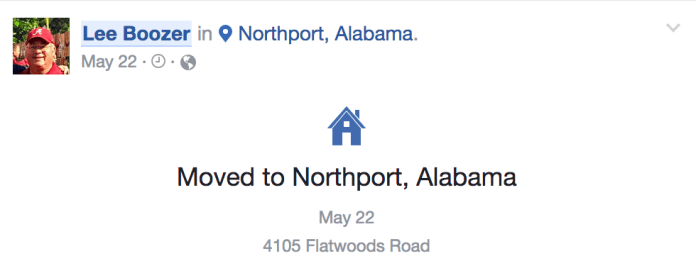
Hambright’s replacement Lee Boozer had only moved to Northport recently.  Although his Facebook Page gave May 22 as when he moved into a house on Flatwood Road, Boozer told a reporter that he had moved to his new home on March 29, 2016. He also said that construction began on August 11, 2016.

Boozer May 22

In a Tuscaloosa News article Stephen Dethrage reported that “Boozer bought 20 acres of rural property in Northport and moved there in May 2016, spending time in a ‘man cave’ he built in his barn while the house proper was under construction.”

Alabama Code Title 11 (Counties and Municipal Corporations § 11-44D-4) stipulates:
The council members shall be qualified electors of the city, shall have been residents of the district which they represent for at least 90 days prior to the time of filing their statement of candidacy and shall reside in their district during their term of office.


Boozer said that he had registered as a Northport City voter on April 5, 2017. The ninety day period for residency may not apply to the time period in which an official must have been a qualified elector. The day that Boozer registered was six days short of ninety days.
If Boozer had established residency at Flatwoods Lane ninety days before his appointment on June 28, 2017, then he would have met that qualification.


After Council member Hambright died, the process was clear in securing his replacement. State law allowed the Council 60 days to do so, otherwise the decision would have fallen to the governor. If the governor had declined to make an appointment within 30 days, the Probate Judge could have scheduled a special election.

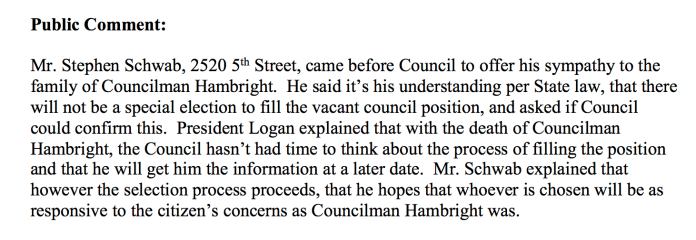
Many citizens of Northport wanted to have a chance to vote for a Council Member who would be serving what would be almost a full term. When a resident attempted to bring up his concerns at the May 15th Council meeting, Council President Jay Logan abruptly interrupted him.  Stephen Schwab had offered his sympathy to the family of Councilman Hambright before he attempted to ask about the prospect of a special election.


From the Council minutes:
Screen Shot 2017-06-30 at 12.48.06 PM


During the 2017 Northport Municipal election many candidates had run on a the promise of providing a new level of “transparency.”  President Logan had been in favor of increased transparency. But, rather than provide Schwab with any information about replacing Hambright, Logan participated in a secretive process that was anything other than transparent.


The way in which the last Council member was selected by the Council in 2015 ( when District 4 Council member Steve Acker was moving out of his district ) was far more transparent than the way in which Boozer was chosen. Interviews with four prospective members were open to the public and covered by the Tuscaloosa News. The amount of time in that would have been left in Acker’s term was less than in the case with Boozer.


Some residents of Northport might question why the Council appointed a relative newcomer to Hambright’s position. It seemed as if the city was running to beat the clock to find a suitable replacement.


Only a few months ago the Council passed a measure that would allow people who lived outside of Northport to serve on its Civil Service Board. This required the State Legislature to modify the Constitution. Northport had 20,000 or so people who might have served on the board. But that apparently was not enough. Many of Northport’s upper echelon employees live outside of Northport for that matter.


Could the Council have found a replacement for Hambright who had had least established residency without talking about a “man cave”?


It almost seems as if the leadership in Northport might hold its citizens in little regard. But one thing is clear: transparency was just a campaign promise.
Standard

Any road will take you there

Screen Shot 2017-05-30 at 7.40.26 AM

If you don’t know where you’re going, any road will take you there.

The idea behind the Tuscaloosa Forward plan was to let the residents of Tuscaloosa provide their thoughts on how Tuscaloosa should move forward after the April 2011 catastrophic damage by tornadoes. The Tuscaloosa Forward plan that is posted on the city’s website explained its purpose:

The citizens of Tuscaloosa have stepped up to share
their best ideas on what their City can become. This
document could not exist without their input, insight and
great ideas. Further, without the leadership at City Hall
that has been exhibited since the tornadoes of April 15
and April 27, there would be no framework upon which
to capture these ideas, organize them, and have hope to
see them through to a future reality. A thousand thanks
to those listed here, and those many others who have

contributed in some way to this community plan.

The Tuscaloosa Forward document continued:

When disasters strike, the pain and loss are immense and the road to recovery can seem long and tiring. However, disasters can also reveal a resilience and dedication to community that had been hidden by the bustle of “ordinary” days. We are all reminded about what is truly important and community leaders are challenged to rise to the occasion. It is possible to emerge from a disaster a stronger and more capable city than before.

The Tuscaloosa Forward Strategic Community Plan to Renew and Rebuild is an investment in the idea that through smart decision-making and careful planning Tuscaloosa can become a better and stronger city. The plan represents the community’s vision for the future of Tuscaloosa. It establishes a framework that city government, the private sector, and the public can work from to achieve a common vision. The strategic rebuilding plan balances the hundreds of ideas from thousands of residents who gave their time to help imagine how the rebuilding could be done to maximize the impact of the policies, projects, and other investments that will move Tuscaloosa Forward.


The neighborhood advocacy group Tuscaloosa Neighbors Together (TNT) conducted  a survey on the Tuscaloosa Forward plan where 300 respondents were generally in favor of the plan.

The Tuscaloosa City Council unanimously approved the Tuscaloosa Forward plan in September 2011. Jason Morton reported in the Tuscaloosa News that, “Now, the city will turn to the Code Studio consultant firm of Austin, Texas, to help craft building codes, zoning rules and other policies that will turn the elements of the Tuscaloosa Forward plan into reality.”

At the time TNT’s Secretary Joan Barth said, “The consensus is that people want (small businesses) to come back. But no, we don’t want it to go back the way it was. These are changes that (residents) wanted to see.”

Many citizens who participated in the Tuscaloosa Forward planning process have observed that, time and time again, that the recommendations in the plan have been been ignored as often as they have been realized.

Inflated land values were the result when the storm left large areas in Tuscaloosa with a clean slate. To a great extent, anticipated real estate values dictated how successful the fulfillment of the Tuscaloosa Forward plan would be.

But, as well as inflated property values being a impediment to the plan, many developers approached the city with an attitude that, “if I can’t have my way, I’ll take my ball home and the game’s over.” For example, a Shell gas station that resembles many of the developer’s other truck stops sticks out like a sore thumb on 15th Street. Its huge brightly light canopy and signage can’t be missed. The zoning that resulted from the Tuscaloosa Forward plan called for gas pumps to be located in the back. The developer insisted on the canopy’s location in front of the building. The art rendering of the proposed gas station presented to the Planning and Zoning Commission did not include the canopy. Many people were shocked by the appearance of the gas station when it was built.

Many people who participated in the Tuscaloosa Forward process were enthusiastic about Village Centers with their potential for connectivity and housing that had varying price ranges.

A variety of housing styles, densities, and price ranges are concentrated within and around Village Centers to provide housing options for residents of different ages, incomes, and lifestyles. This concentration of housing helps to create a critical mass of residents to support the services and amenities provided within the Village Centers and enhances their viability. Focusing housing around Village Centers also maximizes the number of people who are able to access the Village Center by walking, biking, or a short drive. Along the tornado path where the impact was most severe, there are entire blocks and subdivisions of homes that were almost completely destroyed. In these areas the challenge of rebuilding goes beyond reconstructing individual homes where they once stood. It is to rebuild entire neighborhoods and create places where communities can flourish. This big idea is to create Model Neighborhoods that illustrate new ways to house the citizens of Tuscaloosa in a manner that addresses both pre-existing challenges and emerging needs. These Model Neighborhoods can help to rebuild Tuscaloosa at the sites where they are located, but they also demonstrate techniques and practices that can be applied across the tornado-affected areas and even citywide.

Elements that could be incorporated into model neighborhoods, and into residential development throughout the city include:
Neighborhood design that seamlessly integrates a variety of housing styles, densities, and price ranges to provide options and serve diverse needs
Techniques for integrating pocket parks and open space as amenities within neighborhoods
Energy efficiency and water conservation features to reduce housing costs
Home design and construction methods that are durable, safe, healthy, and environmentally sustainable while remaining affordable
Creative strategies to finance quality housing for developers, owners, and renters
Innovative approaches to home maintenance and property management to improve the visual appearance and longevity of housing
Housing construction and neighborhood design techniques that apply quality new housing in a manner that is tailored to, and compatible with local characteristics and needs

Showpiece sustainable design that includes green building, efficient infrastructure, emerging technology, and natural grasses that clean stormwater and provide ornament.

In May of 2017 Mayor Walter Maddox proposed a new plan, as Jason Morton reported in the Tuscaloosa News, “to address a number of areas of concern, from land left undeveloped after the April 27, 2011, tornado to road and infrastructure projects that have been planned for years.”

Maddox explained this program, a proposal for which he plans to submit to the City Council later this year, is meant to tackle pockets of undeveloped areas of city.

“We want to do our part to incentivize that rebuilding,” the mayor said. “Right now, those vacant pieces of property are generating very little in terms of revenue for our city.”

Much of the land in question is in areas that were cleared by the tornado that damaged or destroyed 12 percent of the city in 2011.


Some residents are concerned about that the vacant pieces of property will not be used in a way that reflects the Tuscaloosa Forward aspirations. An absence of affordable housing is a major concern.

This is particularly the case in the Alberta area where major variances and rezoning have allowed the construction of an abundance of multi-family housing projects which have relatively high rental price points. Quite often unrelated students can afford such housing whereas single families cannot.

Was the Tuscaloosa Forward plan too ambitious an undertaking? Or was it only an exercise in public relations that was never to be taken seriously?
Standard

A Terrified Pachyderm?

proportion+nature

Is the Administration at the University of Alabama like a tiny trembling pachyderm who is terrified by a giant mouse? Is The Machine  a huge rodent that gnaws away on any pretense of ethical student conduct when it comes to campus politics.

A article in the campus newspaper The Crimson White (CW) “A look at The Machine’s influence — Breaking Down The Machine” b

SGA [Student Government Association] elections at The University of Alabama are rarely boring. In the most recent contest, candidates drew significant interest for scandals, campaign violations and owning up to membership in an infamous campus secret society. For the first time in the University’s history, a candidate for SGA president publicly said he was backed by Theta Nu Epsilon, a group of campus sororities and fraternities commonly referred to as The Machine.

“Anybody on [the SGA Executive Council] who was looking at doing something [The Machine] didn’t like, or running against them for a position in the future…their threat is going to be like, ‘If you do this, besides individual consequences, we are going to take this out on your entire house too,’ and that is often a very powerful thing,” the individual said.

The consequences for not following The Machine’s wishes typically includes threats of an individual’s fraternity or sorority not having swaps, and also turning the individual into a social outcast.

Additionally, the source said while many University administrators do not necessarily hold favorable opinions of The Machine, a “stranglehold” still exists on administrators preventing them from acting against The Machine.

Just what sort of “stranglehold” would the The Machine have? One person was quoted in the CW article as saying, “The easiest way to explain it is that administrators are scared to do anything because they think they’re going to lose their jobs for it.”

Much has been made of the fact that a Machine backed black candidate for the first time in the University’s history was elected as SGA President in 2017. Not everyone thinks that means a lot. Recently elected SGA Senator Mike Smith in the CW article thinks that things will soon return to the traditional way of doing things.

“They don’t care about diversity, equality or inclusion, no matter how many meaningless SGA events they throw,” Smith said. “The Machine messed up with Stevie Keller a few years back, so they nominated a woman and a black man back-to-back to regain control… after two years of getting over 50 percent, I promise you the basement will throw up a white conservative Old Row fraternity guy for president next year.”

Standard